Broker Check
Retirement Savings: How Much Do You Need to Retire Comfortably?

Retirement Savings: How Much Do You Need to Retire Comfortably?

Retirement savings are the accounts, investments, and cash reserves you set aside to help support your life after full-time work becomes optional. But saving for retirement is not only about building a large account balance. It is about knowing what you are saving for, how your money is invested, how taxes may affect your income, and how those assets can eventually support the life you want to live.

For many people, retirement begins with a 401(k), IRA, employer match, or investment account. Over time, those pieces need to work together. A strong strategy can help you understand how much to save, where to save it, how to invest it, and how your assets may one day become income.

At Strategic Investment Management, we help individuals and families in Austin and beyond approach retirement savings with purpose, vision, and direction. As an Austin-based fiduciary financial advisory firm, we help clients connect their retirement accounts, investment decisions, tax picture, insurance needs, and long-term goals into a coordinated plan.

Whether you are still building wealth, getting close to retirement, or already drawing income from your assets, the right guidance can help you make informed decisions with the money you have worked hard to build.

Key Takeaways About Retirement Savings

  • Retirement savings include more than one account. They may include employer-sponsored plans, IRAs, Roth IRAs, taxable investment accounts, cash reserves, pensions, annuities, and other long-term assets.
  • The amount you need depends on your lifestyle, expenses, retirement age, health, income sources, tax situation, family needs, and desired flexibility.
  • A strong retirement strategy connects savings, investments, taxes, healthcare costs, insurance, and future withdrawals.
  • For Austin and Texas residents, retirement planning should also account for property taxes, housing costs, healthcare access, lifestyle goals, and the absence of state income tax.
  • A fiduciary financial advisor can help you evaluate your savings within the context of your full financial life, not just one account at a time.

What Are Retirement Savings?

Retirement savings are funds specifically set aside to support your future income needs after you stop working or reduce your working hours. These savings may include employer-sponsored retirement plans, individual retirement accounts, brokerage accounts, cash reserves, pensions, annuities, and other long-term assets.

Common retirement savings accounts include:

  • 401(k), 403(b), or 457 plans
  • Traditional IRAs
  • Roth IRAs
  • SEP IRAs or Solo 401(k)s for self-employed individuals
  • Taxable investment accounts
  • Health Savings Accounts, when used as part of a long-term healthcare strategy
  • Pensions
  • Annuities
  • Cash reserves

The goal is not simply to accumulate as much money as possible. The goal is to build a coordinated strategy that can support income, preserve purchasing power, manage taxes, and provide flexibility throughout retirement. That coordination matters because the account you use today may affect the taxes you pay later, the investment risk you take, the income available to you in retirement, and the options you have when life changes.

Why Are Retirement Savings Important?

Retirement savings are important because they help replace the income you may no longer receive from work. Without adequate retirement savings, you may have to rely too heavily on Social Security, reduce your lifestyle, delay retirement, or make difficult financial decisions later in life.

A thoughtful retirement planning strategy can help connect your retirement savings to your income needs, healthcare planning, tax picture, investment approach, and desired lifestyle.

A strong retirement savings strategy can help you:

  • Create income for essential expenses
  • Maintain flexibility for travel, hobbies, family, and giving
  • Prepare for healthcare and long-term care costs\
  • Reduce the risk of outliving your assets
  • Manage taxes before and during retirement
  • Adjust when markets, expenses, or personal priorities change
  • Make decisions with a clearer understanding of tradeoffs

Your savings also give you choices. They may allow you to retire on your preferred timeline, shift to part-time work, support family, relocate, volunteer, start a business, or pursue work because you want to, not because you have to.

At SIM, we believe retirement planning should begin with the life you are trying to support. The account balances matter, but they are only part of the picture. Your savings should be connected to your income needs, tax planning, investment approach, insurance coverage, estate considerations, and personal priorities.

How Much Retirement Savings Do You Need?

The amount of retirement savings you need depends on your lifestyle, expenses, retirement age, income sources, health, family situation, and long-term goals. There is no single retirement savings number that applies to everyone.

A helpful starting point is to answer these questions:

  • When do you want work to become optional?
  • How much do you spend now?
  • Which expenses may increase or decrease in retirement?
  • How much income will come from Social Security, pensions, rental income, or other sources?
  • How will healthcare costs be covered?
  • Do you plan to travel, relocate, give, help family, or pursue major purchases?
  • How long might your assets need to last?
  • How much flexibility do you want if plans change?

In Austin, retirement savings planning should also account for local realities such as housing costs, property taxes, healthcare access, and lifestyle preferences. Texas has no state income tax, which can be beneficial for retirees, but property taxes and housing costs can still play a significant role in long-term cash flow planning.

If you are in the years leading up to retirement, Strategic IM’s pre-retirees resources can help you think through your timeline, income strategy, and next steps.

Retirement Savings by Life Stage

Your strategy should change as your life changes. A person in their 30s needs a different approach than someone five years from retirement, and someone already retired needs a different strategy than someone still accumulating assets.

If You Are Still Building Wealth

If you are earlier in your career or still actively building assets, the focus is usually on saving consistently, using available accounts wisely, and investing with enough time horizon for growth.

Important steps may include:

  • Capturing the full employer match if available
  • Automating contributions
  • Increasing savings as income grows
  • Choosing between pre-tax and Roth contributions
  • Building emergency reserves
  • Avoiding unnecessary early withdrawals
  • Investing consistently instead of trying to time the market

At this stage, small decisions can compound over time. The goal is to create habits and account structures that give your future self more options.

If You Are 5 to 10 Years From Retirement

The years before retirement are often the most important planning window. You may still have time to adjust contributions, refine your investment allocation, reduce debt, evaluate healthcare options, and begin thinking about future withdrawals.

Key questions include:

  • Are you saving enough for your preferred retirement timeline?
  • How much income will your savings need to generate?
  • Is your portfolio taking the right amount of risk?
  • Should you consider Roth contributions or Roth conversions?
  • How will taxes affect future withdrawals?
  • What role will Social Security play?
  • How will healthcare costs fit into your plan?

This is where Strategic IM’s fiduciary guidance can be especially valuable. We help clients look beyond the account balance and evaluate how retirement income, investment risk, taxes, insurance, and lifestyle decisions fit together.

If You Are Already Retired

Once you retire, the focus shifts from accumulation to coordination. Your savings may need to provide income, manage taxes, respond to market changes, and support unexpected expenses.

Important considerations may include:

  • Which accounts to withdraw from first
  • How to manage Required Minimum Distributions
  • How Social Security fits into your income plan
  • How to keep enough liquidity for near-term needs
  • How to invest for both income and long-term growth
  • How charitable giving or family support fits into the plan
  • How to adjust when spending changes

In retirement, your strategy should not sit still. It should be reviewed as markets, tax laws, health needs, and personal priorities evolve.

What Is the Best Way to Start Retirement Savings?

The best way to start retirement savings is to begin with a clear goal, automate contributions, and use the accounts available to you. For many employees, that means contributing to a workplace retirement plan and capturing the full employer match if one is offered.

A practical retirement savings sequence may include:

  • Build an emergency fund, so short-term expenses do not derail long-term savings.
  • Contribute enough to capture your full employer match if your workplace plan offers one.
  • Increase contributions gradually as your income grows.
  • Use an IRA or a Roth IRA when it fits your tax situation.
  • Invest consistently rather than trying to time the market.
  • Review your plan regularly as your life changes.

If most of your retirement savings are in an employer-sponsored plan, working with a 401(k) financial advisor can help you evaluate contributions, investment options, costs, tax planning, and future withdrawal decisions.

Starting early can help, but starting intentionally matters at any age. The most important step is building a retirement savings plan that reflects your real life, not a generic benchmark.

How Much Can You Contribute to Retirement Savings Accounts in 2026?

For 2026, the IRS increased several retirement savings contribution limits. Employees who participate in 401(k), 403(b), most 457 plans, and the federal Thrift Savings Plan can contribute up to $24,500. The IRA contribution limit increased to $7,500. The 401(k) catch-up contribution limit for those age 50 and older increased to $8,000, while the IRA catch-up contribution limit for those age 50 and older increased to $1,100.
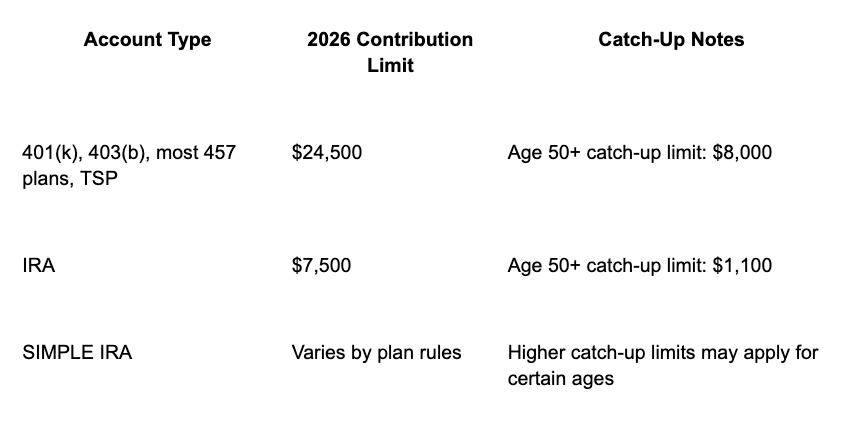
These limits matter because they shape how much retirement savings you can direct into tax-advantaged accounts each year. However, the right contribution amount depends on your income, cash flow, tax situation, and overall financial plan.

Which Retirement Savings Accounts Should You Use?

The best retirement savings account depends on your employment status, tax bracket, income level, and long-term goals. Most people benefit from using more than one type of account over time.

401(k), 403(b), or 457 Plans
Employer-sponsored plans are often the foundation of retirement savings. They allow automatic payroll contributions, tax advantages, and potential employer matching. If your employer offers a match, contributing enough to receive the full match is often one of the most valuable retirement savings moves available.

Traditional IRA
A Traditional IRA may allow deductible contributions, depending on your income and whether you are covered by a workplace plan. Traditional IRA retirement savings grow tax-deferred, and withdrawals are generally taxed as ordinary income.

Roth IRA
A Roth IRA is funded with after-tax dollars. Qualified withdrawals may be tax-free in retirement, which can make Roth retirement savings especially useful for tax diversification. Roth IRAs can also provide flexibility because they do not have required minimum distributions during the original owner’s lifetime.

Taxable Investment Accounts
Taxable investment accounts do not offer the same upfront tax advantages as retirement accounts, but they can provide flexibility. These accounts may be useful for early retirement, major purchases, or supplemental income planning before beginning withdrawals from retirement accounts.

If you are changing jobs or consolidating old workplace plans, the Rollover IRA vs. 401(k) decision deserves careful review. The right choice can affect investment flexibility, fees, taxes, creditor protection, and long-term retirement savings strategy.

How Should Retirement Savings Be Invested?

Retirement savings should be invested according to your time horizon, risk tolerance, income needs, and long-term financial goals. The right investment mix will likely change as you move from saving for retirement to living in retirement.

Key investment considerations include:

  • Your age and expected retirement date
  • How much risk can you tolerate emotionally
  • How much risk your plan may require
  • Your need for income versus growth
  • Inflation and purchasing power
  • Diversification across asset classes
  • Tax efficiency
  • Liquidity needs
  • The timing of future withdrawals

Retirement savings that are too conservative may not keep pace with inflation. Retirement savings that are too aggressive may expose you to unnecessary volatility, especially as withdrawals get closer.

SIM’s Austin investment services can help align your retirement savings with your risk tolerance, income needs, and long-term goals.

How Do Taxes Affect Retirement Savings?

Taxes affect retirement savings in two major ways: how money goes into an account and how money comes out. Traditional retirement savings accounts may offer tax deductions today, but withdrawals are typically taxable later. Roth accounts do not usually provide an upfront deduction, but qualified withdrawals may be tax-free.

A tax-aware retirement savings strategy considers:

  • Whether to save pre-tax or Roth
  • When Roth conversions may make sense
  • How Required Minimum Distributions may affect future taxes
  • How Social Security taxation may be impacted
  • Which accounts to withdraw from first
  • How charitable giving may fit into the plan
  • How taxable investment accounts are managed
  • How tax planning changes before and after retirement

For Austin and Texas residents, the absence of state income tax can be helpful. Still, federal taxes remain a major retirement savings consideration, especially for people with large pre-tax balances.

If your retirement savings strategy touches multiple areas of your financial life, Strategic IM’s fiduciary financial services page provides a broader view of how retirement planning, financial planning, investment management, and insurance analysis can work together.


Retirement Savings Considerations for Austin Residents

Retirement planning in Austin should reflect both national retirement issues and local realities.

Austin residents may need to consider:

  • Housing costs and whether to stay, downsize, or relocate
  • Texas property taxes and how they affect long-term cash flow
  • Healthcare access and potential out-of-pocket costs
  • The role of federal taxes on retirement income
  • Family support, gifting, or legacy goals
  • Lifestyle costs tied to travel, hobbies, community, and giving
  • Whether retirement will include part-time work, consulting, or business ownership

Texas does not have a state income tax, which can be beneficial for retirees with taxable retirement income. However, that does not eliminate the need for tax planning. Federal taxes, property taxes, investment taxes, and estate considerations can still affect your long-term plan.

For Strategic IM clients, local guidance is not just about geography. It is about having an advisor who understands the way real financial decisions show up in everyday life: where you live, how you spend, who depends on you, and what kind of flexibility you want your assets to support.

Common Retirement Savings Mistakes

Many retirement savings mistakes happen gradually. They may not feel urgent in the moment, but they can create long-term consequences.

Common mistakes include:

  • Waiting too long to start retirement savings
  • Not contributing enough to receive the full employer match
  • Saving without a clear retirement income goal
  • Investing too conservatively or too aggressively
  • Ignoring fees and expenses
  • Forgetting to update beneficiaries
  • Overlooking tax diversification
  • Treating retirement savings as separate from the rest of your financial life

The best retirement savings strategies are reviewed and adjusted over time. Your income, family needs, tax picture, health, and goals will change. Your plan should evolve with them.

How a Fiduciary Financial Advisor Help With Retirement Savings

A fiduciary financial advisor can help you turn retirement savings into a coordinated strategy. Instead of looking at each account in isolation, a fiduciary advisor evaluates how your savings, investments, taxes, income needs, and long-term goals work together.

At Strategic Investment Management, our Austin-based fiduciary financial advisors help clients make retirement savings decisions with clarity and care. That may include reviewing employer plans, comparing Roth and Traditional options, evaluating investment allocations, estimating income needs, and coordinating with tax professionals.

Working with a fiduciary advisor in Austin can help you evaluate retirement savings within the context of your full financial life. If you are looking for local guidance, an Austin financial advisor can help you connect your retirement savings to your broader goals, tax picture, investment strategy, and long-term financial plan.


FAQs About Retirement Savings

What is retirement savings?
Retirement savings are the money and investment assets you set aside to help fund your life after full-time work. These savings may include 401(k)s, IRAs, Roth IRAs, taxable accounts, pensions, and other long-term assets.

How much retirement savings should I have?
The right amount of retirement savings depends on your age, income, lifestyle, expenses, health, retirement timeline, and expected income sources. A personalized plan can help estimate how much you may need.

What is the best account for retirement savings?
The best retirement savings account depends on your situation. Many people start with a 401(k), especially if an employer match is available, then consider a Traditional IRA, Roth IRA, or taxable investment accounts for additional flexibility.

Is retirement savings different from retirement planning?
Yes. Retirement savings are the assets you build for the future. Retirement planning is the broader strategy for how those assets will be invested, taxed, withdrawn, protected, and used to support your life.

When should I start retirement savings?
You should start saving for retirement as soon as possible, but it is never too late to build a more intentional strategy. Starting earlier gives your money more time to grow, while starting later may require more focused planning.

Build Retirement Savings With Purpose

Retirement savings are not just numbers on a statement. They represent your future income, your flexibility, your independence, and the life you want to build beyond work.

A strong retirement savings strategy helps you answer important questions, such as: Am I saving enough? Am I using the right accounts? Am I investing appropriately? Will my income last? How will taxes affect my plan?

At Strategic Investment Management, we help individuals and families create comprehensive financial plans designed around their real goals. If you are ready to take a clearer look at your retirement savings, our team is here to help.

Ready to review your retirement savings? Contact Strategic Investment Management to schedule a consultation and start building a retirement savings strategy that supports your goals and the comfortable lifestyle you envision for retirement.


Schedule A Conversation Today

This analysis is based on publicly available information, including SEC filings, company statements, and financial media reports, as of December 2025. Readers should verify IPO statuses independently as circumstances change rapidly.