Broker Check
401(k) Planning for Retirement and Long-Term Financial Goals

401(k) Planning for Retirement and Long-Term Financial Goals

401(k) planning helps you make thoughtful decisions about one of your most important retirement assets. Whether you are building savings, approaching retirement, changing jobs, or deciding what to do with an old employer plan, Strategic Investment Management can help you understand how your 401(k) fits into your broader financial plan.

Your 401(k) should not be managed in isolation. It should work alongside your retirement income needs, investment strategy, tax situation, insurance coverage, estate priorities, and long-term goals.

Key Takeaways

  • 401(k) planning connects your workplace retirement account to your full financial picture.
  • The right strategy may include contribution planning, investment review, tax awareness, and rollover guidance.
  • Your 401(k) planning decisions can affect retirement income, risk, taxes, and long-term flexibility.

What Is 401(k) Planning?

401(k) planning is the process of deciding how to use your employer-sponsored retirement plan as part of a larger financial strategy. It includes how much you contribute, whether you use traditional or Roth contributions when available, how your investments are allocated, and how the account may eventually support retirement income.

For many professionals, pre-retirees, and business owners, a 401(k) is among the largest retirement assets they hold. That makes it important to review not only the account balance, but also the decisions behind it.

What Should You Review in Your 401(k)?

A strong 401(k) planning process should look at both the account itself and the role it plays in your future.
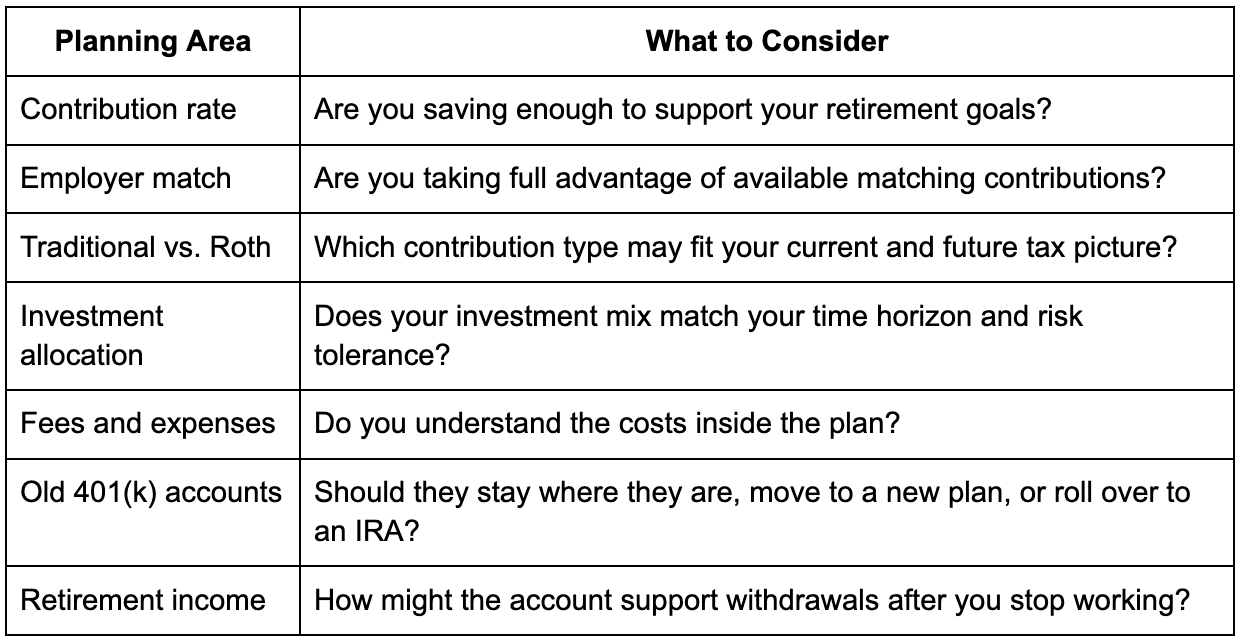
The goal is not to make a one-time decision. It is to keep your 401(k) planning aligned with your life as your income, goals, family situation, and retirement timeline change.

How Much Can You Contribute to a 401(k)?

Contribution limits can change from year to year, so 401(k) planning should include regular reviews. For 2026, employees can generally contribute up to $24,500 to a 401(k). Participants age 50 and older may be eligible for an additional catch-up contribution, and workers ages 60–63 may qualify for a higher catch-up limit.

These limits are helpful, but they are not the only factor. The right contribution amount depends on your cash flow, tax situation, employer match, other savings, retirement timeline, and personal priorities.

Should You Choose Traditional or Roth 401(k) Contributions?

Traditional and Roth 401(k) contributions are taxed differently. Traditional contributions may reduce taxable income today, while Roth contributions are made with after-tax dollars and may provide tax-free qualified withdrawals later.

There is no single right answer for everyone. Your decision may depend on your current income, expected retirement tax bracket, years until retirement, cash flow needs, and whether your plan offers Roth features. A tax-aware 401(k) planning strategy can help you evaluate which option may make sense for your situation.

How Should Your 401(k) Be Invested?

Your 401(k) investment strategy should reflect your goals, risk tolerance, and time horizon. Younger savers may have more time to ride out market fluctuations, while pre-retirees may need to think more carefully about downside risk, liquidity, and future withdrawals.

That does not mean your portfolio should automatically become conservative as retirement approaches. It means your investment allocation should be intentional. Strategic Investment Management can help you review whether your 401(k) investments fit with your broader retirement planning and wealth management strategy.

What Should You Do With an Old 401(k)?

If you have changed jobs, you may have one or more old 401(k) accounts. Your options may include leaving the money in the former employer’s plan, moving it to a new employer’s plan, rolling it into an IRA, or taking another permitted distribution.

Each option has tradeoffs. Investment choices, fees, creditor protection, access to advice, tax treatment, and retirement income needs should all be reviewed before making a rollover decision. A rollover is not automatically the right move, and it should be evaluated in light of your full financial picture.

How Can 401(k) Planning Support Retirement Income?

As retirement approaches, your 401(k) shifts from primarily a savings vehicle to a potential source of income. That transition requires careful planning.

You may need to decide when to begin withdrawals, which accounts to use first, how to coordinate income with Social Security, and how required minimum distributions may affect your future taxes. Your 401(k) planning should be part of a coordinated retirement income plan, not a separate account with a separate strategy you review only once a year.

Why Work With Strategic Investment Management?

Strategic Investment Management is an Austin-based fiduciary financial advisory firm that helps individuals, families, pre-retirees, retirees, and business owners make informed financial decisions. Our role is to help you understand your options, organize your finances, and build a strategy aligned with your goals, values, and circumstances. This often includes personalized 401(k) planning for our Austin-area clients.

If your 401(k) is a major part of your retirement plan, we can help you evaluate how 401(k) planning fits into your broader strategy for retirement, financial, investment management, and insurance analysis.

Learn more about our retirement and 401(k) planning services, our guidance for pre-retirees, our support for business owners, and what it means to work with a 401(k) financial advisor.

Frequently Asked Questions About 401(k) Planning


What is 401(k) planning?

401(k) planning is the process of deciding how to contribute, invest, manage, and eventually withdraw from your 401(k) as part of a broader retirement and financial plan.

How much should I contribute to my 401(k)?

The appropriate amount depends on your income, expenses, employer match, savings goals, retirement timeline, and tax situation. Many people start by contributing enough to capture the full employer match, then increase contributions over time when possible.

Should I use a Roth 401(k) or traditional 401(k)?

It depends on your tax situation today and what you expect in retirement. Traditional contributions may provide a current tax benefit, while Roth contributions may provide tax-free qualified withdrawals later.

Can an advisor help with my old 401(k)?

Yes. A financial advisor can help you compare whether to leave assets in an old plan, move them to a new employer plan, or roll them into an IRA based on fees, investment choices, taxes, and your overall plan.

Is 401(k) planning only for people close to retirement?

No. 401(k) planning can be useful at every career stage. Early savers may focus on contributions and investment growth, while pre-retirees may focus more on risk, taxes, rollovers, and retirement income.

Make 401(k) Planning Part of a Bigger Plan

401(k) planning helps you make informed decisions about contributions, investments, employer matches, rollovers, taxes, and retirement income. A well-designed strategy connects your workplace retirement account to your broader financial plan so your savings, investments, and future income work together.

Whether you are building retirement savings, changing jobs, or preparing to retire, regular 401(k) planning and reviews can help keep your plan aligned with your goals and changing circumstances. Schedule a meeting to discuss your 401(k) with a financial professional at Strategic Investment Management.

Schedule A Conversation Today

This analysis is based on publicly available information, including SEC filings, company statements, and financial media reports, as of December 2025. Readers should verify IPO statuses independently as circumstances change rapidly.