Broker Check
Investing in IPOs: How to Evaluate the Risks Before You Buy

Investing in IPOs: How to Evaluate the Risks Before You Buy

Investing in IPOs means buying shares of a company when it first offers stock to the public. An IPO, or initial public offering, can give investors access to a newly public company, but investing in IPOs also comes with unique risks, limited operating history, pricing uncertainty, and potential volatility.

For some investors, the appeal is obvious. IPOs can feel like a chance to get in early before a company becomes widely known. But the reality is more complicated. Investing in IPOs requires careful analysis of the company, the offering documents, your access to shares, your risk tolerance, and how the investment fits within your broader financial plan.

But investing in IPOs should not be driven by hype, headlines, or fear of missing out. Before you buy, it is important to understand the business, review the prospectus, evaluate the risks, consider your access to shares, and decide whether the investment belongs in your broader portfolio.

At Strategic Investment Management, we help investors in Austin and beyond evaluate opportunities through a disciplined, fiduciary lens. Whether you are a business owner, technology professional, pre-retiree, retiree, or long-term investor considering a new opportunity, IPO investing should be weighed against your goals, time horizon, tax picture, risk tolerance, and total investment strategy.

Key Takeaways About Investing in IPOs

  • Investing in IPOs means buying shares of a company when it first becomes public or shortly after public trading begins.
  • Individual investors may not be able to access IPO shares at the offering price. Investor.gov notes that no brokerage firm can guarantee an investor will be able to purchase shares in an IPO.
  • IPOs can be volatile because newly public companies often have limited public reporting history, uncertain valuations, and changing investor demand.
  • Before buying, investors should review the prospectus, understand the business model, evaluate risk factors, and decide how the position fits within their broader portfolio.
  • A fiduciary financial advisor can help determine whether an IPO should be treated as a limited speculative position, avoided altogether, or approached through a more diversified investment strategy.

What Is an IPO?

An IPO is an initial public offering. It generally refers to the first time a company sells shares of stock to the public. Before an IPO, the company is privately held. After the IPO, its shares may trade on a public exchange, allowing individual and institutional investors to buy and sell shares.

Under federal securities laws, a company generally must register an offering with the SEC or qualify for an exemption before offering or selling shares. The SEC explains that companies typically register an IPO by filing a registration statement, often using Form S-1, and the prospectus is a key part of that filing.

The prospectus is important because it describes the company, the offering terms, risk factors, use of proceeds, management, ownership structure, and financial information. It will not eliminate risk, but it can help you understand what you are buying.

How Does Investing in IPOs Work?

Investing in IPOs starts with the company, underwriters, and the registration process. The company works with investment banks to prepare the offering, set an expected price range, market the shares, and allocate available shares to eligible investors.

For investors, IPO investing can happen in two main ways:

  • Buying IPO shares at the offering price through a brokerage platform, when available
  • Buying shares after the stock begins trading publicly

These are not the same experience.

Buying at the offering price means purchasing shares before they begin trading on the public market. However, individual investors often have limited access to those shares. Broker-dealers may receive only a small allotment, and access can depend on eligibility requirements, account size, trading history, client status, and firm policies.

Buying after trading begins means purchasing shares on the public market. At that point, the price may be higher or lower than the offering price. A stock that receives heavy attention may rise quickly, while another may fall soon after trading starts.

That distinction matters. When people talk about “getting in early,” they may assume they can buy at the IPO price. In reality, many individual investors are buying only after the stock is already trading and the market has begun repricing the shares.

Why Are Investors Interested in IPOs?

Investors are often interested in IPOs because they want exposure to companies with high growth potential. Some IPOs involve businesses in technology, healthcare, energy, consumer products, financial services, or emerging industries.

  • Interest in a company’s long-term growth story
  • Desire to access a newly public business early
  • Potential for price appreciation
  • Exposure to a specific industry or trend
  • Excitement around a recognizable brand
  • Familiarity with the company as a customer, employee, vendor, or business owner

For Austin investors, the appeal may feel especially familiar. In a city shaped by technology, entrepreneurship, and business growth, it is not unusual for investors to hear about newly public companies through work, peer conversations, media coverage, or professional networks. Familiarity, however, is not the same as investment suitability.

A company can be innovative and still be overpriced. A brand can be exciting and still be risky. A business can have long-term potential and still be the wrong fit for your portfolio.

What Are the Risks of Investing in IPOs?

Investing in IPOs can be risky because newly public companies often have limited public reporting history, uncertain valuations, and higher price volatility. The stock may rise quickly, fall sharply, or trade unpredictably once it reaches the public market.

Key risks include:

  • Limited public history: Investors may have fewer years of public financial statements to review.
  • Valuation risk: IPO pricing may reflect optimism about future growth rather than proven profitability.
  • Volatility: IPO shares can experience sharp price swings after trading begins.
  • Allocation risk: Individual investors may receive limited or no access to shares at the offering price.
  • Lockup expiration risk: When insider lockup periods end, additional shares may become available for sale.
  • Concentration risk: A large IPO position can create unnecessary exposure to one company or sector.
  • Liquidity and timing risk: If the stock falls soon after purchase, investors may have to decide whether to hold, sell, or add more, with little public track record to guide their decision.
  • Tax risk: Short holding periods, gains, losses, and timing decisions can all affect the investment's tax impact.

The SEC specifically encourages investors to review the prospectus and understand the company, its risks, and the terms of the offering before investing.

What Should You Review Before Investing in an IPO?

The best way to approach investing in IPOs is to slow down and evaluate the opportunity as you would any other investment. A recognizable company or exciting industry does not automatically make an IPO a good fit.

Before investing in IPOs, consider these questions:

  • What does the company actually do?
  • Is the business profitable, or does it depend on future growth?
  • How is the IPO priced relative to revenue, earnings, or competitors?
  • What risks are disclosed in the prospectus?
  • Who is selling shares, and why?
  • How much of your portfolio would this represent?
  • What is your reason for buying?
  • What would cause you to sell?

This is where professional guidance can be valuable. Strategic IM’s Austin investment services are designed to help investors evaluate opportunities through a broader portfolio lens rather than a single stock idea.

Should IPOs Be Part of Your Investment Strategy?

IPOs may have a place in some investment strategies, but they should usually represent a limited and carefully considered portion of a portfolio. Investing in IPOs is generally more speculative than investing in diversified funds or established companies with longer public track records.

For many investors, IPO exposure may be better approached through diversified vehicles rather than a large single-company position. Others may decide that the risk, uncertainty, or volatility does not fit their goals.

A disciplined strategy for investing in IPOs and other opportunities should consider:

  • Your time horizon
  • Your ability to absorb losses
  • Your tax situation
  • Your need for liquidity
  • Your current portfolio concentration
  • Your long-term financial goals

Strategic IM’s broader fiduciary financial services can help connect IPO investing questions to financial planning, retirement planning, investment management, and risk management.

Should IPOs Be Part of Your Investment Strategy?

IPOs may have a place in some investment strategies, but they should usually represent a limited and carefully considered portion of a portfolio. Investing in IPOs is generally more speculative than investing in diversified funds or established companies with longer public track records.

For many investors, IPO exposure may be better approached through diversified vehicles rather than a large single-company position. Others may decide that the risk, uncertainty, or volatility does not fit their goals.

IPO Investing vs. Long-Term Investing

IPO investing often attracts attention because it feels immediate and exciting. Long-term investing usually works differently. It is less about catching a headline and more about building a portfolio that supports your life over time.

Here is a simple comparison:
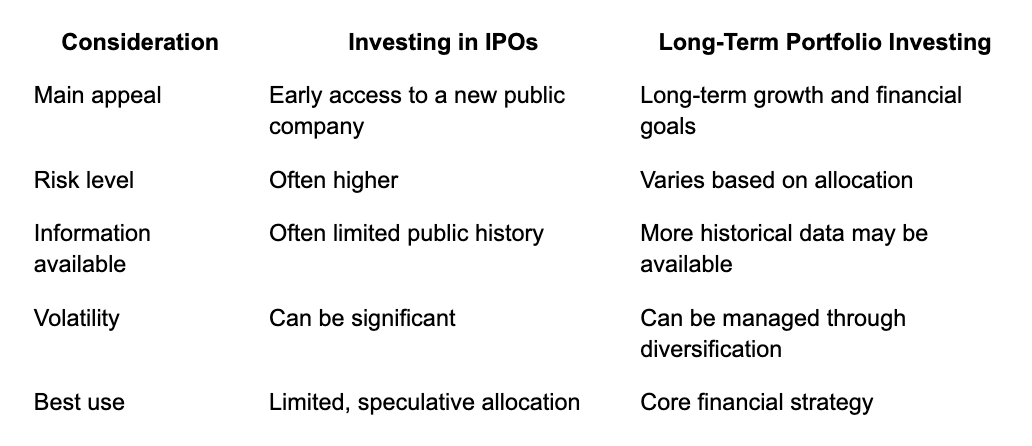
Investing in IPOs should not replace a comprehensive investment plan. If you do invest, the position should fit within your existing asset allocation, risk tolerance, and long-term strategy.

What Should You Read Before Investing in IPOs?

Before investing in IPOs, review the company’s prospectus. This document includes important details about the business, financials, risks, use of proceeds, management, ownership structure, and offering terms.

A prospectus will not eliminate risk, but it can help you understand what you are buying when investing in an IPO. Pay close attention to:

  • Revenue trends
  • Profitability or losses
  • Debt levels
  • Customer concentration
  • Competitive risks
  • Regulatory risks
  • Insider ownership
  • Use of IPO proceeds
  • Lockup agreements

If the document feels too complex to evaluate, pause. Investing in IPOs without understanding the underlying company can turn a long-term strategy into a guess.

How Can a Fiduciary Advisor Help With Investing in IPOs?

A fiduciary advisor can help you evaluate whether investing in IPOs fits your goals, risk tolerance, and overall financial plan. Rather than looking at an IPO in isolation, a fiduciary advisor considers how the investment affects your total portfolio.

That may include:

  • Reviewing the IPO’s role in your asset allocation
  • Evaluating concentration risk
  • Comparing the opportunity with other investments
  • Considering tax implications
  • Creating rules for position size and exit strategy
  • Keeping emotion from driving the decision

Working with a fiduciary advisor in Austin can help you make investment decisions with more clarity and accountability. Strategic IM’s team focuses on providing purpose, vision, and direction through personalized guidance, fiduciary service, and long-term planning.

IPO Considerations for Austin Investors

Austin investors may encounter IPO opportunities through professional networks, technology employers, startup communities, media coverage, or conversations with peers. That proximity can make a company feel more familiar, especially if it operates in an industry you understand.

Familiarity can be helpful, but it can also create blind spots. Knowing a brand, using a product, or understanding an industry does not automatically mean the stock is priced attractively or fits your portfolio.

For Austin-area professionals, business owners, and families, IPO evaluation should be connected to broader financial questions:

  • Do you already have concentrated exposure to one company or industry?
  • Would this investment affect your retirement timeline?
  • Could a loss change your cash flow, tax planning, or family goals?
  • Is the decision based on disciplined analysis or local excitement?

How does the opportunity compare with your current investment strategy?

Strategic IM helps clients connect investment decisions to the rest of their financial lives, including retirement planning, tax considerations, insurance needs, income planning, and long-term financial independence.

How Can a Fiduciary Advisor Help With Investing in IPOs?

A fiduciary advisor can help you evaluate whether investing in IPOs fits your goals, risk tolerance, and overall financial plan. Rather than looking at an IPO in isolation, a fiduciary advisor considers how the investment affects your total portfolio.

That may include:

  • Reviewing the IPO’s role in your asset allocation
  • Evaluating concentration risk
  • Comparing the opportunity with other investments
  • Considering tax implications
  • Creating rules for position size
  • Discussing what would trigger a sale
  • Evaluating whether diversified exposure may be more appropriate
  • Keeping emotion from driving the decision

Working with a fiduciary advisor in Austin can help you make investment decisions with more clarity and accountability. At Strategic IM, our role is not to chase every opportunity. It is to help you evaluate which decisions support your financial life and which ones may add risk without enough purpose.

FAQs About Investing in IPOs

What does investing in IPOs mean?

Investing in IPOs means buying shares of a company when it first offers stock to the public or shortly after those shares begin trading. IPO investing can offer access to newly public companies, but it also involves risk, volatility, and uncertainty.

Is investing in IPOs risky?

Yes. Investing in IPOs can be risky because newly public companies may have limited public history, uncertain valuations, and significant post-IPO price swings. Investors should review the prospectus and understand the risks before buying.

How do individual investors buy IPO shares?

Individual investors may be able to buy IPO shares through a brokerage firm if they meet that firm’s eligibility requirements. However, access to IPO investing is not guaranteed, and many investors buy shares only after public trading begins.

Are IPOs good for beginners?

IPOs are often not ideal for beginners because they can be more speculative and harder to evaluate than established investments. Beginners may benefit from building a diversified foundation before considering investing in IPOs.

How much should I invest in an IPO?

There is no universal amount. If investing in IPOs fits your strategy, the position should usually be limited enough that a loss would not derail your broader financial plan.

Evaluate IPOs With a Clear Investment Strategy

Investing in IPOs can be exciting, but excitement should not be the reason you buy. A newly public company may have long-term potential, but it may also carry valuation risk, limited public history, and sharp volatility.

Before investing in IPOs, take time to understand the company, review the prospectus, consider your access to shares, and decide whether the investment supports your broader financial goals.

At Strategic Investment Management, we help individuals and families evaluate investment decisions with clarity, discipline, and fiduciary care. If you are considering investing in IPOs or want to understand how a new opportunity fits within your portfolio, our team can help.

Ready to evaluate your investment strategy? Contact Strategic Investment Management to schedule a consultation with an Austin-based fiduciary financial advisor.

This analysis is based on publicly available information, including SEC filings, company statements, and financial media reports, as of December 2025. Readers should verify IPO statuses independently as circumstances change rapidly.